

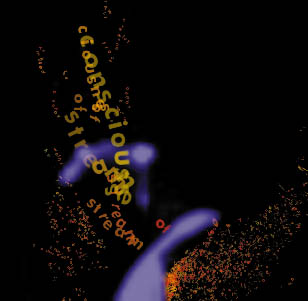
 As we mentioned in our reviews of Tahereh Mafi’s Shatter Me, the main character’s style is a little different from what most readers may be used to: stream of consciousness.
What is it? Glad you asked.
It’s a style of writing that portrays a character’s point of view by
giving the written equivalent of the character’s thought processes, either in a loose interior monologue, or in connection to his or her actions.
The writing is sometimes hard to follow as the character leaps from one thought to another, and often, proper grammar and punctuation go out the window. It’s usually used to focus on the emotional and psychological processes that are taking place in the minds of one or more characters. Important character traits are revealed through an exploration of what is going on in the mind.
For example (no spoilers, promise!):
Each is standing with his left fist pressed to his heart. Frozen in place.
Black and gray
and
black and gray
and
black and gray
and
bleak.
You can find different degrees of stream of consciousness in a couple modern YA books: Maggie Stiefvater uses it in The Wolves of Mercy Falls series; and Laurie Halse Anderson used it in Wintergirls.
From Forever (pp. 115-116):
I was
bubbling breath
clay in my mouth
black-star vision
a moment
then a moment
then I was
Grace.
Classic literary examples include:
- William Faulkner’s The Sound and the Fury, As I Lay Dying, Absalom, Absalom!
- F. Scott Fitzgerald’s The Great Gatsby
- Ken Kesey’s One Flew Over the Cuckoo’s Nest (especially Chief Bromden’s thoughts during electroshock therapy.
- Chuck Palahniuk’s Fight Club
- Sylvia Plath’s The Bell Jar
- J. D. Salinger’s The Catcher in the Rye
Now that you know what it is, what other examples can you think of, especially from YA?
 Novel Novice
The Knife of Never Letting Go by Patrick Ness
Interesting! I hadn’t really heard of this before.