


Synopsis:
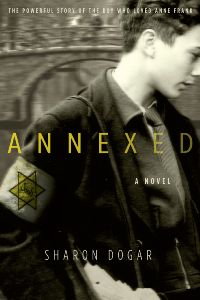 On July 13, 1942, 15-year-old Peter van Pels and his parents entered the attic that became their home for two years. Peter is angry that he is hiding and not fighting Nazis. He is also not happy to be sharing cramped living quarters with the Franks, especially know-it-all Anne. In this novel, Dogar “reimagines” what happened between the families who lived in the secret annex immortalized in Anne Frank’s diary. In doing so, she creates a captivating historical novel and fully fleshes out the character of Peter, a boy whom teens will easily relate to. He agonizes over whether he will ever make love to a girl, fights with his parents, sulks, and questions God and religion before finally maturing into a man. While this novel focuses on his adolescent struggles in the face of unthinkable adversity, the most compelling dilemma he faces is figuring out who he is. (From Wendy Scalfaro, G. Ray Bodley High School, Fulton, NY)
Before you read our review, please watch this video featuring the author, Sharon Dogar:
Review:
I’ve been given the nearly impossible job of reviewing a book that recounts — albeit fictionally — the very real systematic dehumanization and slaughter of millions of people. I didn’t sign up for this job; Annexed was thrown in with another book I’d requested from the publisher.
And yet it is my job — our job — to remember.
I remember seeing Schindler’s List in the theater with my mother when it came out in 1993. I was still pretty young and it made quite an impression. As I sat there trying to control my hiccuping sobs, I kept thinking, “This happened. This happened. This is a movie but this happened! It’s in history books, but there are still people alive today that witnessed this! How did this happen?!”
In Annexed, a historical fiction “reimagining” of the events and people described in Anne Frank’s diary, Peter wonders the same thing. He wonders how he ended up living in cramped quarters with the Frank family; he wonders how he comes to love the previously obnoxious Anne; he wonders how he missed the signs that they were about to be discovered; and he wonders how on earth Jews are the chosen people of God, when it seems that God has abandoned them.
We see Peter question is faith, his identity, and in the end, he questions whether anyone will ever know what really happened. He had no way of knowing his time in the annex would be preserved for eternity in the pages of Anne’s diary. And the real Peter had no way of knowing his story would also find a voice through author Sharon Dogar.
Dogar had the tough job of taking a sensitive topic and translating it for 21st-century readers. She had to walk a fine line between what we know happened and respecting the memories of the real people, and making it “sellable” according to today’s literary norms.
Dogar has been accused of “sexing up” Anne’s account, and I can see where this criticism comes from, but I also understand that Peter probably saw things differently than Anne, both because he was older and because he started out as a healthy, teenage boy with all the feelings and hormones that entails. There’s nothing trashy or over-the-top gratuitous about Annexed.
Dogar’s writing really shines when she imagines Peter’s voice after Anne’s diary abruptly ends. She follows them into the train cars that ship them first to a holding camp, and then to the death camps. This section is relatively brief, but poignant. Its stark and fevered style mimics the otherworldly nightmare that was Auschwitz.
Peter asks again and again, “Are you there? Are you listening?”
I can confidently say that yes, Peter, thanks in part to Sharon Dogar, we are listening.
 Novel Novice
I agree with the author that we are at a turning point in history. With the voices of those who survived the Holocaust fading, we need to supplement factual accounts with fiction.
Thank you for sharing this video. I posted it on my classroom blog because we’re studying Elie Wiesel’s Night right now and several of my students are looking for more Holocaust-related materials.
I can’t wait to see what else this week brings.
There will be a Q&A, a discussion guide, “The Writing of … ” and essay and project ideas. There’s also a book called “Broken Birds” by Jeannette Katzir that we’re looking into and is somewhat related. It came out in June, I think. Might be worth a look.
It sounds like such an emotional and powerful read.
Anything having to do with that period is enough to give you the chills both because of the atrocity of the actions then and for the depth of connection between people back then, forced to live in hiding…
Thanks for this rec/review.
I saw this book on the shelves of where I generally puchase books from and I picked it up and read the blurb on the back. I put the book back, but must say I left there thinking how interesting it would be to read this fictional account of a book of what Peter may of been thinking/feeling during this horrible era in our world’s history. I wondered myself what those who were directly affected and their descendants would think. Now that you have reviewed this book and the video explains a little more I think I will return and purchase this book.
The question I think we all need to ask is “Has society learnt from history and do we care enough to make our world a happier safer place for all? I think not and that’s terribly sad.