


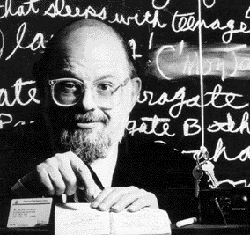
 During this third week of National Poetry Month, our featured poet is Allen Ginsberg.
Ginsberg (1926-1997) is best-known as one of the eclectic, forward-thinking group of artists called The Beats, which also included the likes of Jack Kerouac, William Burroughs, Gregory Corso, and many other writers. There were several avenues of thought and schools of poets that developed out of the Beat Generation, but Ginsberg was kind of the poster child for a generation that railed against social conformity.
Michael Schmidt, the author of Lives of the Poets says this of Ginsberg:
Ginsberg helped turn marginal forms of behavior into norms: psychedelic drugs, distrust of government institutions, sexual explicitness, guiltless hedonism, fear of nuclear energy.
Ginsberg was a controversial figure throughout his life. A practicing Buddhist and openly gay man, he was an early and fearless advocate of gay rights and went against the prevailing cultural norms of the time by being openly homosexual. He asserted that he was becoming normal by accepting his homosexuality, though one of his early therapists recommended that he “go straight” and get married. But in 1954 Ginsberg met the man who would be his lifelong partner, poet Peter Orlovsy.
This poem “Howl” is Ginsberg’s most famous work. It was written in the postwar culture of the 1950s, when the idea of “being yourself” was, frankly, suspect. It was regarded as an incredibly shocking piece that pushed the envelope in multiple (some said criminal) ways. But this poem broke open a closed door on the issues of silence, madness, and suicide… and how society drove his friends to extremes.
Walt Whitman was Ginsberg’s biggest role model, and he imitated Uncle Walt’s long lines and epic style of free verse. Both men strived enthusiastically to produce a truthful voice, to blatantly blast apart the norms of the societies around them. Ginsberg gave himself permission to say anything in his poems… to let his language go wherever it needed to go and to be intensely personal in his poetry.
It’s impossible to condense a life and influence like Ginsberg’s into one blog post… so stay tuned this week as we look at various aspects of his writings like our posts on T.S. Eliot and Sylvia Plath.
Until tomorrow, here are a few brief clips of some folks you may recognize discussing their encounters with Ginsberg:
And here is a quirky moment between Ginsberg and Bob Dylan… at the grave of Jack Kerouac:
What do you think of Ginsberg? Radical or logical?
 Novel Novice
Leave a comment