


It’s exciting to be apart of the current deluge of fantasy fiction in YA literature; Books like Twilight and Harry Potter have been hailed as conduits that have led to renewed reading among children and young adults and have provided kindling to fuel the world’s fascination with witches and wizards and all manors of fantastical and paranormal beings.
Magic has historically held mass appeal for humans; the idea that we have the power to shape our world, not only embraces mystery of the unknown, but also (and perhaps most dangerously), empowers individuals from within. With a boy wizard being the most talked about obsession of recent literary history, it’s hard to imagine that fraternizing with witches in America’s puritanical past had the power to cause mass hysteria, ludicrous trials, and grotesque executions.
Of course, the subject of magic is far from safe. Most people are aware of the uproar fueled by Laura Mallory, Georgia’s infamous Harry Potter adversary, and other religious folk convinced that J.K. Rowling was encouraging their children to practice witchcraft. Some even went so far as to accuse Rowling herself of devil worship. But the extreme are often the loudest, and despite moral panic, the Harry Potter series managed to escape the fury without a lynching.
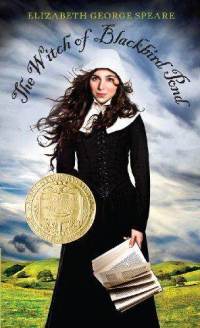 Understanding the reality behind society’s abhorrence towards magic is what makes The Witch of Blackbird Pond by Elizabeth George Speare, relevant to today’s readers. Its early colonial setting, although far removed from our contemporary world, is intrinsically tied to our magic-dominated bookshelves. It’s a coming-of-age story set in New England’s Wethersfield – a disturbing reminder of the devastation caused by prejudice and superstition:
Kit Tyler is marked by suspicion and disapproval from the moment she arrives on the unfamiliar shores of colonial Connecticut in 1867. Alone and desperate, she has been forced to leave her beloved home on the island of Barbados and join a family she has never met. Torn between her quest for belonging and her desire to be true to herself, Kit struggles to survive in a hostile place. Just when it seems she must give up, she finds a kindred spirit. But Kits friendship with Hannah Tupper, believed by the colonists to be a witch, proves more taboo than she could have imagined, and Kit herself is accused of witchcraft! With the threat of execution surrounding her, Kit is forced to choose between her heart and her duty.
The magic of Kit Tyler does not come from a wand, but like our beloved Harry, it comes from an ability to embrace those who are different, think for herself, and question authority – a magic that attracts not only suspicion and fear, but also friendship, romance, and hope. Kit is a strong, female character who represents the all-too-often misunderstood fear behind bigotry and intolerance.
Winner of the Newbery Medal Book, ALA Notable Children’s Book, A Child Study Children’s Book Committee: Children’s Book of the Year, and the New York Public Library–Books for the Teen Age, The Witch of Blackbird Pond is a wonderful blend of historic fact and romantic fiction – a provocative and engaging way to educate children of the seriousness of prejudice, the heritage of fear, and the danger and ultimate gift of imagination. It is definitely a “classic worth reading.”
 Novel Novice
Looks like an interesting book!
I am so excited to see someone feature this book! It was one of my favorites in middle school. I have read it so many times… Highly recommend it. Thanks, Novel Novice, for reminding me I need to reread this soon 🙂
A terrific post. So great to see a classic YA remembered here.
Wow. I thought this title sounded familiar. I looked it up on Amazon and saw a photo of the old cover. I read this book as a kid. It was given to me by my step-mom who just said “Read it. You’ll love it” (or something along those lines). Now, (many, many years later) I don’t remember anything about it other than it was the best book I’d read up to that point in my life. This witch deserves to be revisited! Thanks for bringing back fond memories!