

There are few people who know as much about Old English as Dr. Rebecca Barnhouse. Not only is she an author, but she also teaches medieval literature at Youngstown State University in Ohio. (Yours truly is a former student.) In the following guest blog, Dr. Barnhouse explains the roots of her fascination with medieval literature (Beowulf, in particular) and its influence on the works of J.R.R. Tolkien.
__________
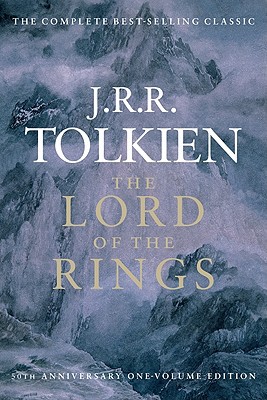 I was in ninth grade when I first read The Lord of the Rings. It was love at first sight. Many readings later, when I was in graduate school, I began to study some of the same languages J.R.R. Tolkien had studied, such as Old English, Old Norse and Gothic, and the stories written in them. As I delved into these strange and wondrous books from the past, a sense of familiarity struck me. One text after another brought me unexpected meetings with old friends. Take, for example, the Old Norse Prose Edda. A section about dwarves includes the names Bifurr, Báfurr, Bömburr, as well as Fili, Kili, Dóri, Óri, Glóinn and Thorinn. Anyone who’s read The Hobbit will see the similarities with Tolkien’s dwarf names, as I did to my great delight while ensconced in my library study carrel. From the same list of dwarf names in the Edda comes the Old Norse name Gandálfr, which means “sorcerer elf.” I love thinking about the way Tolkien’s wizard, Gandalf, combines elements of dwarf, elf, and sorcerer (although admittedly, the dwarf part is a stretch).
In my Old English classes, a similar thing happened when we got to the riddles: I was transported back to a familiar scene, the familiar underground chamber where Bilbo and Gollum have their riddle contest. About a hundred Old English riddles survive in a manuscript known as The Exeter Book, but unlike The Hobbit’s riddles, not a single one is solved. Some answers are obvious, but many have no easy solution. You can see them in both Old English and in translation here: http://www2.kenyon.edu/AngloSaxonRiddles/texts.htm.
 The language of the Old English period—spoken from about 600-1100—sounds foreign to the modern ear, but when I first studied it, I found myself on those grassy plains of Rohan as one familiar word after another rose up before me. Not only the language but much of the culture of Rohan is modeled on Old English (or Anglo-Saxon) culture. Théoden, is the king of Rohan and his name literally means “king, prince, or lord” in Old English. Éowyn, Éomer, éored—all begin with the Old English word for horse and add a second element. Thus Éowyn means “joy of horses,” while her brother Éomer is, literally, “horseman,” who leads an éored, or “horse troop.” When Éowyn disguises herself as a man, she hides behind the name Dernhelm, or “secret helmet.”
Old English poetry had an equally familiar sound when I began to read it. It relies on alliteration, which I’d seen in the poetry of the Riders of Rohan. You can hear the repetition of m sounds in a line from this lament: “Mourn not overmuch! Mighty was the fallen.” Another poem they sing in Rohan begins, “Where now the horse and the rider?” The words are a close translation of lines from the Old English elegy, “The Wanderer” which asks, “Hwær cwom mearg? Hwær cwom mago?” (Where has the horse gone? Where has the rider gone?). Even the architecture of the early Old English period is used in Rohan. King Théoden’s golden hall isn’t a castle—large stone buildings weren’t used yet in England. Instead, warriors gathered in wooden halls like Théoden’s Meduseld. The word meduseld is Old English for “mead hall,” and the hall itself is reminiscent of the golden-roofed hall that the monster Grendel attacks in the Old English epic poem, Beowulf.
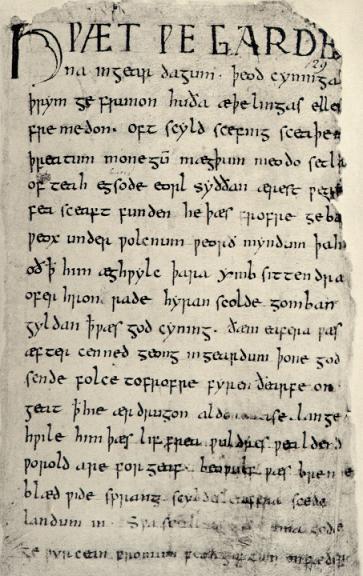 Beowulf had a huge influence on Tolkien’s fiction, as I came to discover when I struggled with its twisting lines. Beowulf himself would have known what Éomer was saying when he addressed his uncle and king with the words, “Westu, Théoden, hal,” in The Two Towers. They are the same Old English words Beowulf uses to greet the Danish king: “Wæs þu, Hroðgar, hal” (Be you, Hrothgar, well). And Smaug the dragon flies straight out of Beowulf into The Hobbit. In both works, a thief awakens a dragon by stealing a single cup from the creature’s vast treasure hoard, which causes it to attack the nearby lands with its breath of flame. Dragons show up elsewhere in Old English literature, even in The Anglo-Saxon Chronicle, no fantasy story, but a sober record of historical events. It reports that in the year 793, fiery dragons were seen flying over Northumbria. Another text, a collection of wise sayings now known as Maxims, tells how various types of people, such as a king and a queen, should act, and states the qualities of natural creatures. “A dragon should live in its barrow, old and proud of its treasure,” it says.
So deeply was Tolkien’s fiction interwoven with the medieval literature and languages that he studied as a scholar that many books have been published on the subject. They detail the very sorts of things I encountered as a graduate student, such as the Old English and Old Norse runic symbols which looked like old friends to me when I first saw them. Of course they did—I’d already seen them on Balin’s tomb in the Mines of Moria and in the G-rune with which Gandalf signed the letter he left for Frodo at The Prancing Pony. Like Frodo not recognizing that Strider was more than he appeared when they first met, I didn’t know the history of Tolkien’s languages and poetry until long after my first encounter with them, back in ninth grade. Understanding more about them has enriched the books for me and given me a greater appreciation for Tolkien as both a scholar and a storyteller.
 Novel Novice
Leave a comment