


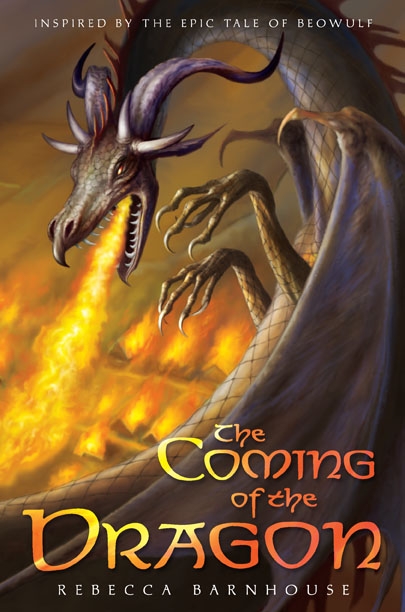
 Happy book birthday to our featured title this week, The Coming of the Dragon by Rebecca Barnhouse! Our thanks to her for answering our questions — and giving us a peek inside her vast knowledge of mythology. Plus, she answers a question about YA that’s been building since a little book called Twilight was published.
__________
Q. What can today’s Young Adult readers take away from mythology, particularly the Scandinavian myths referenced in your new book, The Coming of the Dragon?
A. My novel is set in 6th-century Scandinavia. Many stories from ancient Scandinavian religion survive, but most of them weren’t recorded until the 13th century. That makes it very hard to know what people’s myths, symbols, and rituals would have been like in earlier periods. Some of their religious ideas would have been influenced by local landscapes and customs, so I played with that when I was writing.
For example, there’s a mountain near my main character’s home, and the local people assume that giants (who play a role in many Scandinavian stories) live on it. Most of my characters are followers of the god Thor. They respect Odin, but they’re a little suspicious of the people who favor Odin over Thor. Although we often look for straightforward hierarchies among the Scandinavian gods (with Odin in the highest seat), in the 6th century there were probably lots of local variations in stories and rituals and the relative power given to various gods and goddesses.
Q. What it is about Beowulf that has helped it survive all these centuries?
A. Beowulf can be read on so many levels, which is one of the things that makes it great. It’s an exciting story, well-worth reading for the plot alone: a young hero seeks out a monster and slays it, only to have another monster attack. And then, fifty years later, he has to face a third monster, the dragon that attacks his kingdom. The parts where the monsters show up are deliciously creepy, and because they leave out specific descriptions of Grendel and his mother, they allow audiences to imagine for themselves just how frightening those monsters would be if you met one. As for the dragon fight, there’s furious action along with heart-wrenching emotion—what’s not to like?

Lots of other stories are woven into the poem, and they comment on the main plot and characters in fascinating ways. Old King Hrothgar, whose hall is being attacked by the monster Grendel in the beginning, parallels Beowulf himself, whose kingdom is attacked by another monster when he is an old man. The poet explores ideas about leadership—we see examples of good kings and queens deliberately set against evil ones for comparison. There are glancing references to other heroes and their stories, as well as hauntingly sad poems within the larger poem, like one about the sorrow of the man who has to watch his own son being hanged.
Only a single copy of the poem survives, in a thousand-year-old manuscript that contains a bunch of monster stories. So it seems that tales of the supernatural have been appreciated for a very long time.
Q. Rune, the main character in Dragon, is a reluctant hero. In YA, much has been said about the “reluctant male reader.” What would you say to one to convince them to read your book?
A. Ancient swords and spears and coats of mail! Friendship! Betrayal! Danger! A fight with a terrifying dragon!
Q. Many of our readers are teachers and/or aspiring writers. Writing fiction is hard enough — what can you tell them about writing within the framework of mythology?
A. I struggled to make the mythology come alive in my novel. We’re so accustomed to seeing mythology—the stories associated with a particular religion—neatly packaged and simplified, often for children, instead of being part of something complicated and messy and not easy to categorize. For my characters, Thor and Freyja and giants and dragons are real, and I needed to show how powerful and frightening they could be. I had to see things from my characters’ 6th-century eyes instead of the tidy 21st-century view of Scandinavian mythology.
Q. The Coming of the Dragon isn’t your first Young Adult book. Can you tell us about The Book of the Maidservant?
 A. While The Coming of the Dragon is historical fantasy set at the beginning of the medieval period, The Book of the Maidservant is historical fiction, with no fantasy element, set at the end of the Middle Ages. It’s the story of a serving girl who has to accompany her wacky mistress on a religious pilgrimage to Rome. Along the way, her mistress abandons her in a country where she doesn’t even speak the language. The novel was inspired by The Book of Margery Kempe, which is considered to be the first autobiography in English. Margery, her ill-used maidservant, and the pilgrimage all really happened (although I had to supply a lot of details).
Q. Here’s a question I’ve been dying to ask someone: Today’s YA lit is completely overrun by paranormal romance. From an academic point of view, why is this and what are the effects?
 A. I’ve wondered the exact same thing (but I’ve never studied it as an academic). I’m struck by the way that people who wouldn’t consider themselves fantasy readers often enjoy paranormal romance, never realizing they’re reading fantasy. Perhaps it’s the packaging that makes it more appealing to that audience. I also think paranormal romance takes very old story ideas, such as forbidden love (Romeo and Juliet, anybody?) and makes them seem new and edgy. Girls were falling for bad boys long before Cathy met Heathcliff, but now the bad boys turn out to be werewolves and vampires and fallen angels. So, maybe it’s a case of reading what feels new and different, while getting to hold onto old tales and old values.
Q. You recently announced that The Coming of the Dragon will have a companion book, Peaceweaver, out in 2012. Where are you on that project and what can we expect?
A. It’s been through a couple of drafts, and it’s now with my editor. Readers who come to it without having read The Coming of the Dragon will get a stand-alone novel about Hild, a girl who knows how to wield a sword and who has to decide what’s most important to her: honor or loyalty. Those who have read Dragon will meet many new characters, and they’ll see some familiar faces from a new perspective.
Q. For those who want to know more about mythology, what books would you recommend?
A. For Scandinavian mythology, one of my favorites is Kevin Crossley-Holland’s retelling of the stories in The Norse Myths. I also like H. R. Ellis Davidson’s Gods and Myths of Northern Europe, Lee Hollander’s The Poetic Edda, and two translations of Snorri Sturluson’s The Prose Edda, one by Jean I. Young and one by A. G. Brodeur. I also recommend John Lindow’s encyclopedia, Norse Mythology: A Guide to the Gods, Heroes, Rituals, and Beliefs.
Flash questions!
Q. If you could trade places with one person for a single day, who would it be and why?
A. A scientist like Brian Greene, who does string theory (he wrote The Elegant Universe, among other books). I heard him give a talk once, and I’d love to know what it would be like to think that way, to view the world from a physicist’s perspective.
 Q. What was the last movie you saw?
A. The Young Victoria on DVD.
Q. Biggest TV addiction?
A. Star Trek—The Next Generation on DVD (even though all the characters besides Picard, Geordi, and Data drive me nuts!)
Q. Guilty pleasure?
A. See above and add chocolate.
Q. Fruits or veggies?
A. Both!
Q. Favorite childhood toy?
A. My bike, which allowed me freedom to roam.
 Novel Novice
Leave a comment