


There is a fun interactive feature on MSNBC today, talking about the “science” of Alice in Wonderland. Here are a few highlights:
Mercury made hatters mad
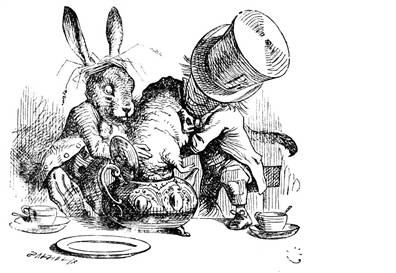
Was the Hatter of the Mad Tea Party truly mad? Literary scholars suggest that the character is a nodding reference to the fact that many hatters did indeed go mad in the 19th century. In Lewis Carroll’s day, hatters often used mercury to cure top hats, such as the one worn by the Hatter. Scientists have since learned that mercury poisoning causes kidney and brain damage. Among the effects are tremors and shaky limbs, called hatter’s shakes, and an irritable temperament. In Burton’s film, the flowing red locks of the Mad Hatter (played by Johnny Depp) are an allusion to mercury poisoning.

But are hares really mad in March?
Joining the Hatter at the famous Mad Tea Party is the March Hare. The phrase “mad as a March hare” was inspired by the belief that male hares go crazy during the March mating season. A 1984 study published in the journal Nature took the belief to task, showing that “‘madness’ is no more a feature of March than of the other months of their long breeding season.”
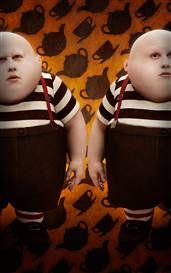
Tweedledee, Tweedledum and genetic mutations
The short and stout stature of the twins Tweedledee and Tweedledum, shown here, serve as an apt analogy for biologists at the University of California at San Diego to describe the effect of a mutation in genes they call Tweedles. The genes make fruit fly larvae appear compressed. Researchers found 27 Tweedle genes in the cuticle, the tough outer coat in fly embryos and larvae. While the exact function of Tweedles are unknown, they are thought to strengthen the cuticle. Make one part too weak or too strong, and the larvae end up resembling their namesake.
From the rabbit hole to Mars
Affection for Alice’s adventures and other childhood tales runs strong among the scientists and engineers who control robotic explorers on the surface of Mars. When NASA’s Phoenix Mars Lander touched down on the Red Planet in the spring of 2008 to look for evidence of water ice, the science team adopted a fairytale and folklore theme to name nearby landmarks. In this image, the lander’s robotic arm comes into contact with a rock called … Alice.
 Novel Novice
Leave a comment